

-
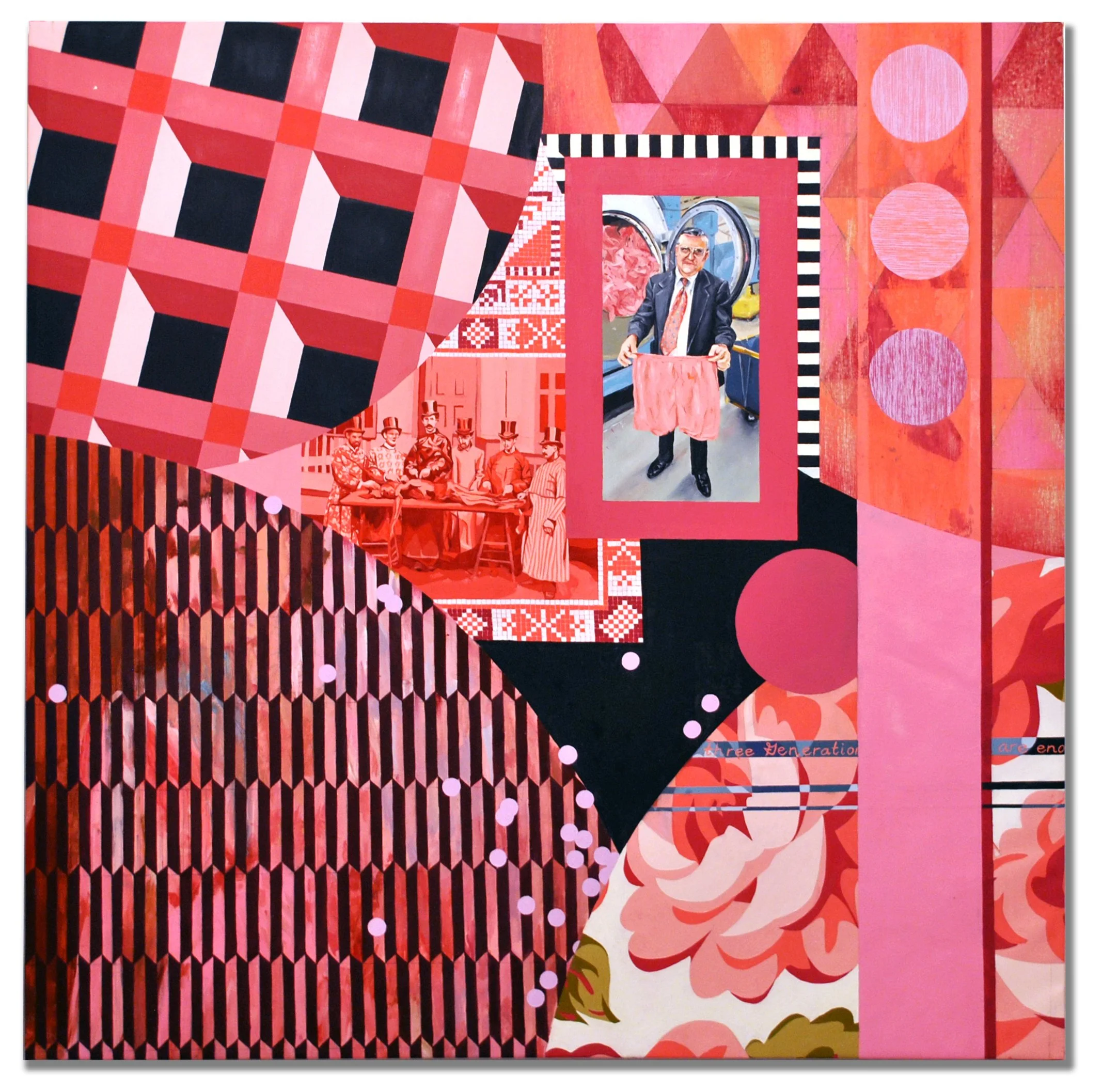
This painting began at Baker-Miller pink, a color theorized in the 1960s by psychologist Alexander Schauss to have a calming effect. This hypothesis was first tested on incarcerated people by its namesakes, two prison directors. It more recently re-entered public consciousness after Kendall Jenner painted a room of her house this color because of its supposed effect as an appetite suppressant. References in the painting grew to include: First Lady Mamie Eisenhower, who is often credited with popularizing pink for women, in her pink inauguration gown; Arizona Sheriff Joe Arpaio, who rose to infamy because of his racist immigration patrols, posed with the pink boxers he forced men incarcerated at "Tent City" to wear; Kentucky medical students engaged in a dissection in the late 1800s when grave robbing, particularly of Black bodies, was on the rise to supply medical schools with cadavers; and a line from Buck v. Bell, a 1927 US Supreme Court decision allowing for compulsory sterilization of the "mentally unfit”, a ruling which still stands. The state's spheres of power extend through the carceral, medical, psychological, and judicial in ways keenly felt by women this summer.
-
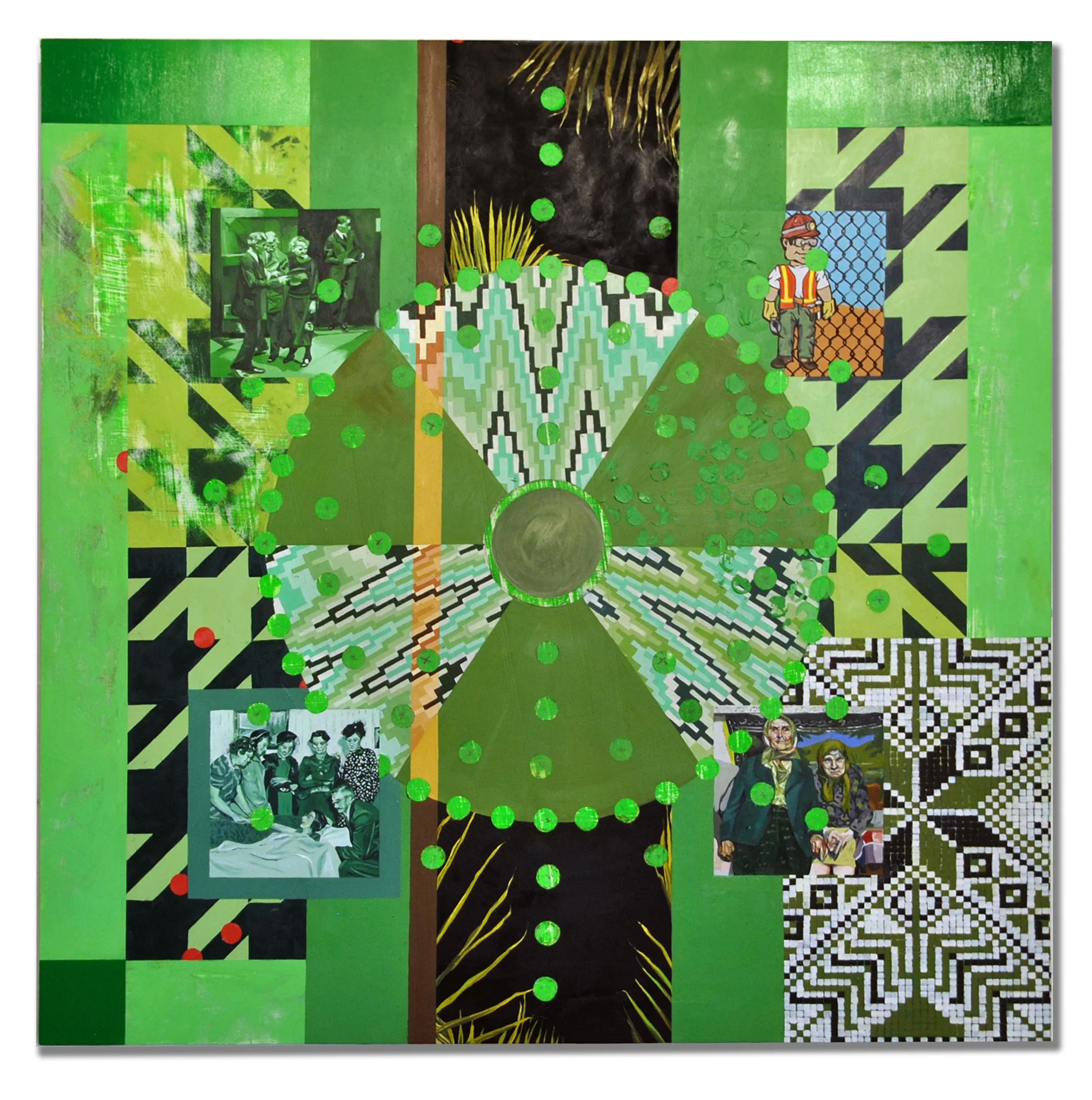
Radium Girls is named for a group of women factory workers, spread across New Jersey, Illinois, and Connecticut. These women suffered serious illness and death as a result of radiation poisoning, contracted from their factory work painting watch dials with radioluminescent paint. Catherine Wolfe Donohue is pictured at the bottom left with her friends and husband. She died at 35, weighing just 71 pounds. The litigation pursued by these women against their employers, who tried to cover up their deaths by attributing them to syphilis, led to the establishment of significant labor and occupational safety rights in the US. The hazard symbol for radioactivity and orderly division of the round clock face laid the structural groundwork for this piece. The atomic structure of radium, painted in phosphorescent paint, glows in the dark. Other references include: Marie Curie, who died of aplastic anemia, likely a result of radiation exposure; Yucca Mountain Johnny, an early 2000s propaganda cartoon created by the Department of Energy to promote the controversial and currently unfunded Yucca Mountain nuclear waste repository project; and two of the so-called Babushkas of Chernobyl, women who reentered the radioactive Dead Zone to reestablish their homes and lives.
-
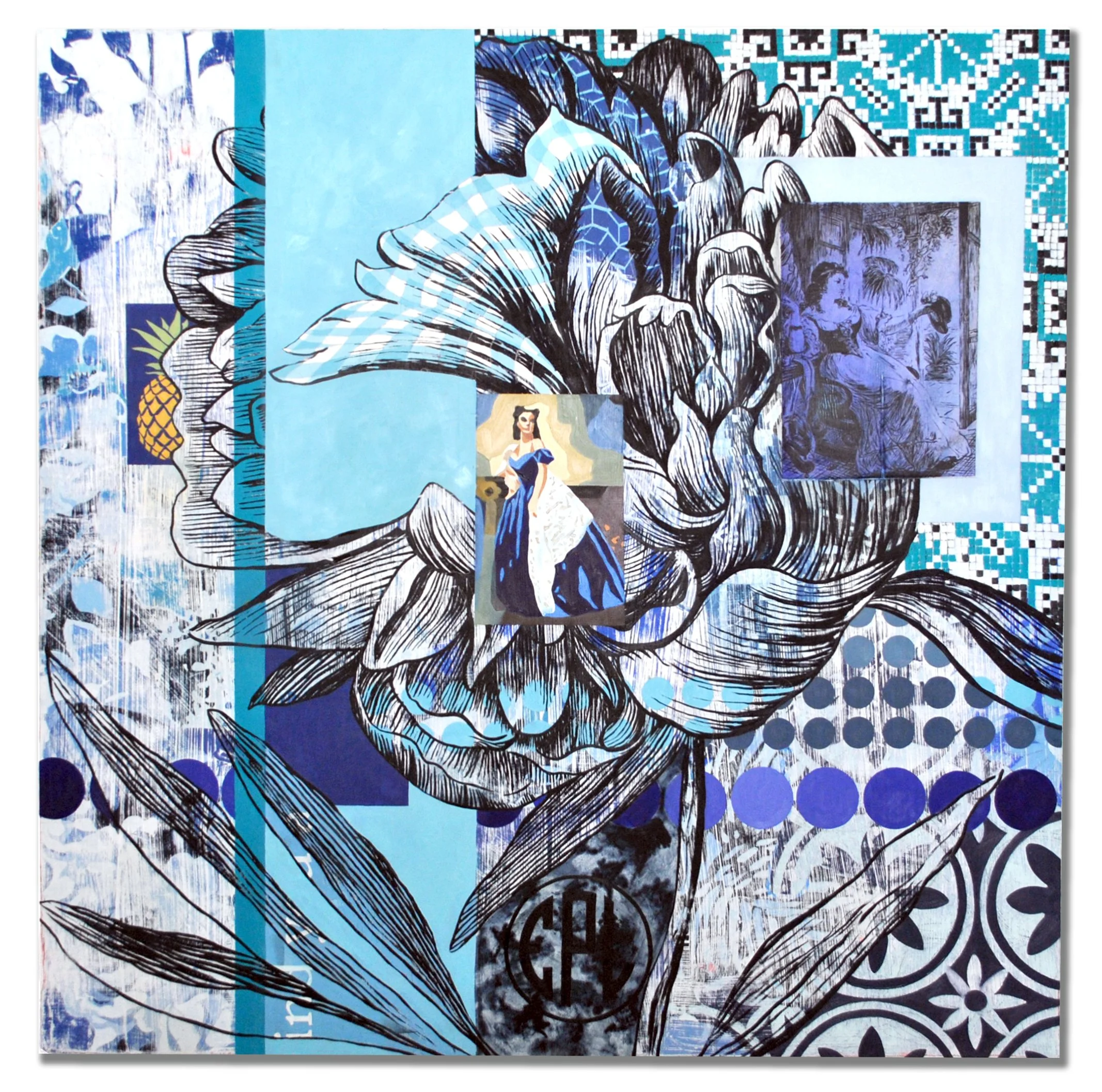
Indigo Girls starts with Eliza Lucas Pinckney, manager of her late husband’s South Carolinian plantations, which relied on the labor of enslaved people. She is credited with establishing indigo as a cash crop and was fashioned into a patriotic symbol of female ingenuity by historian David Ramsay. Her son, Charles Cotesworth Pinckney, would go on to be a Founding Father and champion of the Fugitive Slave Clause. Eliza’s story and its framing have much to tell us about contemporary constructions of white Southern womanhood and our relationship to our own history. Other symbols of wealthy, white Southernhood emerge: the graphic pineapple and monogram that abound on sorority tote bags; the portrait of Scarlett O’Hara that hangs in Rhett Butler’s home in Gone with the Wind; and a “South Carolina belle'' sewing a blue cockade in support of secession.
The paintings on view in Same Source use historical figures and personal mythologies as their starting points, building networked connections through both research and intuition. Working in monochrome allows me to tap into layered associations with color, creating a framework in which to place the intersection between current constructions of white American womanhood and seemingly incongruous histories. By combining decontextualized patterns with recognizable figures, I give form to the overlapping sources key to my own (sometimes frenzied) process of situating my identity in the context of the current American condition.
I am interested in the past, memory, and identity, but also in beauty–in the possibility that an aesthetic reading of the paintings might allow the content to surreptitiously slip past, to plant a seed. Color and: indigo, a Southern cash crop; Baker-Miller pink, a tool of medical and carceral power; radium green, a carcinogen; yellow, an antagonist in Charlotte Perkins Gilman’s “The Yellow Wallpaper”. In these paintings, pattern references imagined domestic spaces, allowing the private sphere to emerge as a complex and contradictory site worthy of our attention. The drawings opposite these works belong to an ongoing series, archive or alphabet. Every pattern has its own internal logic, whether repeating tessellations or organic movements, much like a person. When placed together, conditions of coexistence emerge: harmony and conflict.
Labor is a throughline in this exhibition. In making these works, I was particularly interested in women’s contributions to labor in America and the historical framing of these contributions. How have women like Eliza Lucas Pinckney and the Radium Girls advanced my rights and opportunities as a highly educated middle-class woman? Have they oppressed others to do so? How did they navigate a world and economic system not built for them? Other sources include the non-consensual labor of incarcerated people in medical experiments like those conducted by dermatologist Albert Kligman at Holmesburg Prison; the madness-inducing rest cure banning the protagonist writer of “The Yellow Wallpaper” from working; and the giornata of Italian frescoes, meaning how much work can be done in one day.
The title of this exhibition comes from Adrienne Rich’s poem, “Power” about Marie Curie, who discovered radium and died from her long-term exposure to radiation. She writes:
She died a famous woman denying
her wounds
denying
her wounds came from the same source as her power.