I am a painter, most days. My compositions layer appropriated historical photographs with domestic patterns, scrapbooking what I call “unrigorous research” with our most intimate geometric abstractions. Their collage-like structure mirrors the scraps of women’s internal lives recorded in visual and written archives, treating history as fractured, nonlinear, and echoing.
The patterns I use are pulled from my own homes, Hungarian architecture and textiles, and historical design research. They evoke decor and the unseen labor of home-making. Often enveloping or intruding on figures, the patterns hint at a life that continues at home, one that never made it into the official record, one that sometimes exists within and sometimes beyond systems of state control.
My research begins with the story of a lesser-known woman’s resistance to state abuse perpetrated through medical, judicial, or labor systems. I follow this thread outward, finding repeating patterns in seemingly disparate stories across time. I’m drawn to the friction between violence and decoration—to how injustice coexists with a nice floral print in our everyday lives and environments. I’m curious about how beauty can serve us, how the allure of color might allow content to slip surreptitiously past, radicalizing the living room.
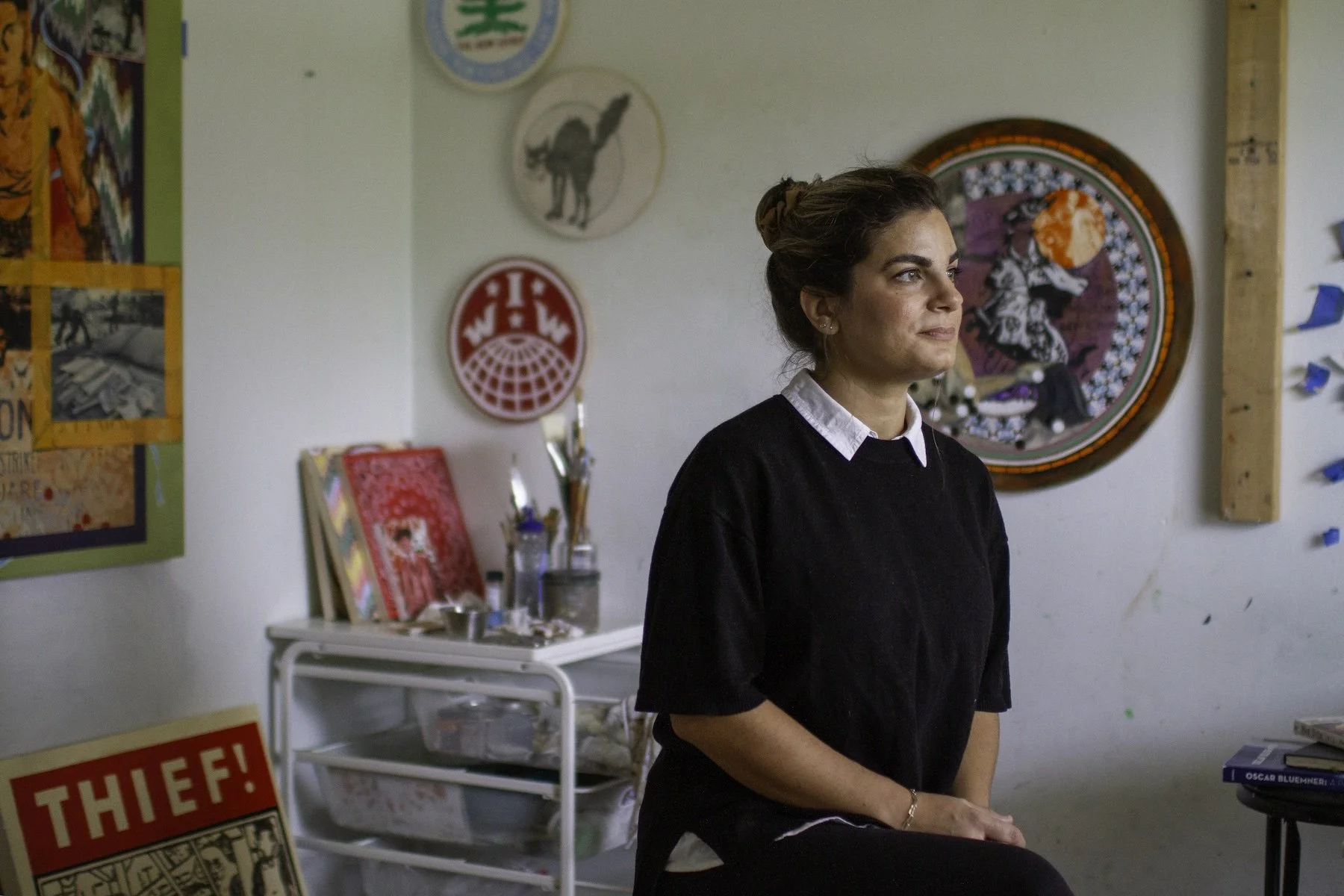
Photograph by Kat Shannon
Luca Molnar (b. 1991, Budapest, Hungary) is a painter, educator, and sometimes-writer based in Central Florida. Molnar grew up mostly in Winston-Salem, North Carolina, where she often felt like an outsider amongst the genteel Southern suburbanites and developed an obsession with Vera Bradley floral prints rooted in equal parts revulsion and aspiration. Her first book, The Mother Game, is an experimental, collaborative artist book of text and images created with Kat Shannon.
Other recent works include Worker Bees, a thirty-eight foot mural installed at the Mennello Museum of American Art in Orlando, which highlights Floridian farmworkers and their advocates; The Beauty of Politics, a body of paintings developed in response to the Hand Art Center’s historic Oscar Bluemner collection and the 1913 Paterson silk strike; Painting Requests from Tomoka, an ongoing collaborative project pairing Community Education Project students incarcerated at Tomoka Correctional Institution with Stetson painting students; and Helybe, a site-specific installation that covered the gallery floor in tile in a Hungarian flame stitch pattern.
Molnar received her MFA from New York University and her BA in Studio Art from Dartmouth College. She is currently an Associate Professor of Studio Art at Stetson University.